


In Australia, Ranchers Almost Never Pour Neatsfoot on an Old Saddle. Here's Why.

It isn't the standard. We spend half our time at the shop talking people out of it.
I moved to Texas 2 years ago, and I've never been more confused in my working life.
My name is Grant Whitfield. I've been a saddler for 24 years. The first 22, I worked out of a saddle shop in Longreach, in central Queensland, Australia.
I moved to Abilene 2 years ago when my wife's family needed us. I took over a small repair shop on the edge of town. Good town. Good people.
And in my first few months behind that counter, I saw something I could not believe.
Customer after customer carrying in an old saddle with the same look on their face.
Ashamed.
Worn out.
Nearly every one of them had been told the same two things.
"Oil it good every spring."
"Or start saving for a new saddle."

I could see it in their eyes. Nobody wants to twist a stiff stirrup around with both hands every time they get on. Nobody wants to wipe grease off their palms and their jeans after every ride.
But that's just what happens when you ride it.
What happens when you don't is worse.
The saddle goes in the trailer tack room for the summer. You saddle up something cheaper. You walk past the old one every morning and tell yourself you'll deal with it next spring.
And then there's what stops happening.
The Saturday ride you used to look forward to. The branding you used to rope at. The trail ride with your grandkids.
You stop riding the saddle that matters most to you.
And the part nobody says out loud.
It never gets better.
Every spring, you oil it heavier. Every summer, it's stiff again sooner. Every year, the seat gets darker and stickier and grabs more dust.
What Nobody Behind a Texas Tack Counter Has Probably Told You
That's why, back in Queensland, we never handed anybody a can of oil when their saddle went stiff.
We dealt with why it went stiff in the first place.
Leather is skin. At the tannery, the hide gets fats worked deep into its fibers. Those fats let the fibers slide past each other every time the leather bends. That's what makes a fender soft and quiet.
Heat pulls those fats out.
Not slowly. Fast.
A trailer tack room or a tin barn hits 120, 130 degrees on a summer afternoon. Every hot day bakes a little more fat out of the leather. Every night, it cools off. Then it happens again the next day. All summer long.
In Queensland, we called it heat cycling.

So the leather goes stiff, and you pour on oil.
But dry leather doesn't drink evenly. The thirstiest spots flood. Most of the oil never soaks in at all. It just sits near the surface.
Then July comes.
With nothing sealing that oil in, the heat cooks it right back out. It sweats onto the seat. It comes off on your jeans. And the inside of the leather is still dry.
In plain language: you're pouring oil on in April, and the sun is taking it back by July.
That's why your saddle can be greasy on top and stiff underneath at the same time.
And that's why every can on your shelf has failed you.
★★★★★Rachel M."I've bought so many different conditioners from the tack shop and they always seem to leave my saddle either greasy or kind of waxy afterward. This one actually soaked in. I wiped it down after and there wasn't that coating left on the leather. It just feels soft and normal again."
Feed It. Then Seal It.
Out where I trained, we were taught that hot-country leather needs 2 things done at once.
Light oils, rubbed in thin, so the leather actually takes them in. Never poured. Never soaked.
Then a little beeswax over the top, buffed dry. The wax holds the oils in, so the heat can't pull them back out.
That isn't oiling.
That's feeding.
And once you understand the difference, pouring oil on a saddle in Texas stops making any sense.
★★★★★Lauren B."I was really hesitant to put anything on this saddle because it's such a light color. Neatsfoot darkened my old one pretty badly, so I tested this underneath first where you wouldn't see it. The color looked exactly the same after it dried, so I went ahead and did the rest. That was honestly the biggest thing for me. I didn't want to ruin the color just trying to condition it."
The Jar I Keep on My Bench
When I went looking for something like what I'd used for 22 years, I couldn't find it in a single store here.
What I found were shelves of neatsfoot compound, silicone shine sprays, and liquid conditioners. A few jars said "natural" on the front and listed petroleum on the back.
So I went looking online for something with the same makeup. Light plant oils that go in. A little beeswax and carnauba to seal. No petroleum, no silicone.
I found a small company that makes one. Milim's Oath.
I tried it on an old bridle first. It went in thin and buffed dry, the way I was taught to expect. So I kept a jar on my bench.

Six ingredients, each with a job:
- 🟢 Cold-pressed hemp seed oil — sinks into dry fibers
- 🟢 Jojoba oil — goes in thin instead of pooling
- 🟢 Shea butter — keeps leather from going brittle
- 🟢 Natural beeswax — seals the oils in
- 🟢 Carnauba wax — buffs to a warm glow, not a slick shine
- 🟢 Vitamin E — protects the blend
No petroleum. No silicone. No dye. Works on saddles, slings, boots, and walnut gunstocks. One jar, leather and wood.
★★★★★Megan L."The first thing I noticed was there wasn't that strong chemical smell some leather products have. I use it on tack and around the house, and I like not having to worry as much when the cats are on the saddle pads or the dog jumps up on the couch. That alone makes me feel better about using it."
The Day Walt Roped Again
The first person I used it on was my father-in-law, Walt.
Walt is 74. He's roped at every branding on his ranch for 50 years, in the same saddle he bought new in 1971.
Last May, on the morning of his grandson's first branding, I found him in the barn trying to twist his stirrup around with both hands.
He couldn't.
He'd oiled that saddle heavy every spring. The seat was greasy as a skillet. The fenders wouldn't bend.
He looked at me and said, "Tell Cody I'll watch from the fence. My back's bothering me."
His back was fine.
He sat on a hay bale all morning and watched his grandson's first branding from the fence. In 50 years, he'd never once missed roping at one.
That night, I knew I had to say something.

The next weekend, we cleaned 3 years of neatsfoot off his saddle. Then I rubbed a thin coat into a spot under the seat jockey. We waited 10 minutes. I handed him a clean rag.
He buffed it and stopped.
"There's nothing on the rag."
"That's right," I said. "It went in."
We did the whole saddle over 3 weeks. Thin coats, a few days apart. And I moved it out of the trailer and into the house.
The seat stopped being tacky.
The fenders started to give.
One morning, he turned the stirrup with one hand and didn't say a word. He didn't have to.
His rope burn was still on the horn. The seat was still worn to his shape. It didn't look new. It looked like his saddle again.
In September, Walt roped all morning at the fall branding.
Cody rode right behind him.
At lunch, Walt set his saddle on the tailgate, put his hand on the horn, and said, "Feels like 1971."

★★★★★Diane H."This was my mom's saddle, and it had been sitting in her barn for almost 30 years. I honestly thought the leather was too far gone. After the first coat, I could already see some of the color coming back. I gave it a couple more over the next few days and the leather softened up a lot. It still looks old, which I'm glad about. It just looks cared for again. That saddle means a lot to me."
After Walt
After Walt, I started showing the same thing to most people who came through my door.
Get it out of the heat. Clean off the old oil. Feed it thin. Seal it.
They stopped coming back every fall with saddles stiffer than the year before. They stopped asking why the seat was sticky. And a lot of good saddles came out of trailer tack rooms and went back on horses.

★★★★★David P."I was conditioning my tack every couple of weeks because it always seemed to dry out again so fast. I used this once and then honestly forgot about it for a while. It's been about four months now and the leather still looks good and feels conditioned. I definitely wasn't expecting it to last that long."
A Can of Oil and a New Saddle Aren't Your Only 2 Options
The reason I'm writing this is simply to tell you that.
I was shocked, when I came to Texas, to find that's all most people with an old saddle are ever told.
Because pouring oil on dry leather doesn't fix why it's stiff.
It floods the surface. Then the heat cooks it back out, and the inside stays dry.
And every summer, the seat gets greasier, the fenders get stiffer, and the saddle goes back in the trailer a little sooner.
Why accept that when you don't have to.
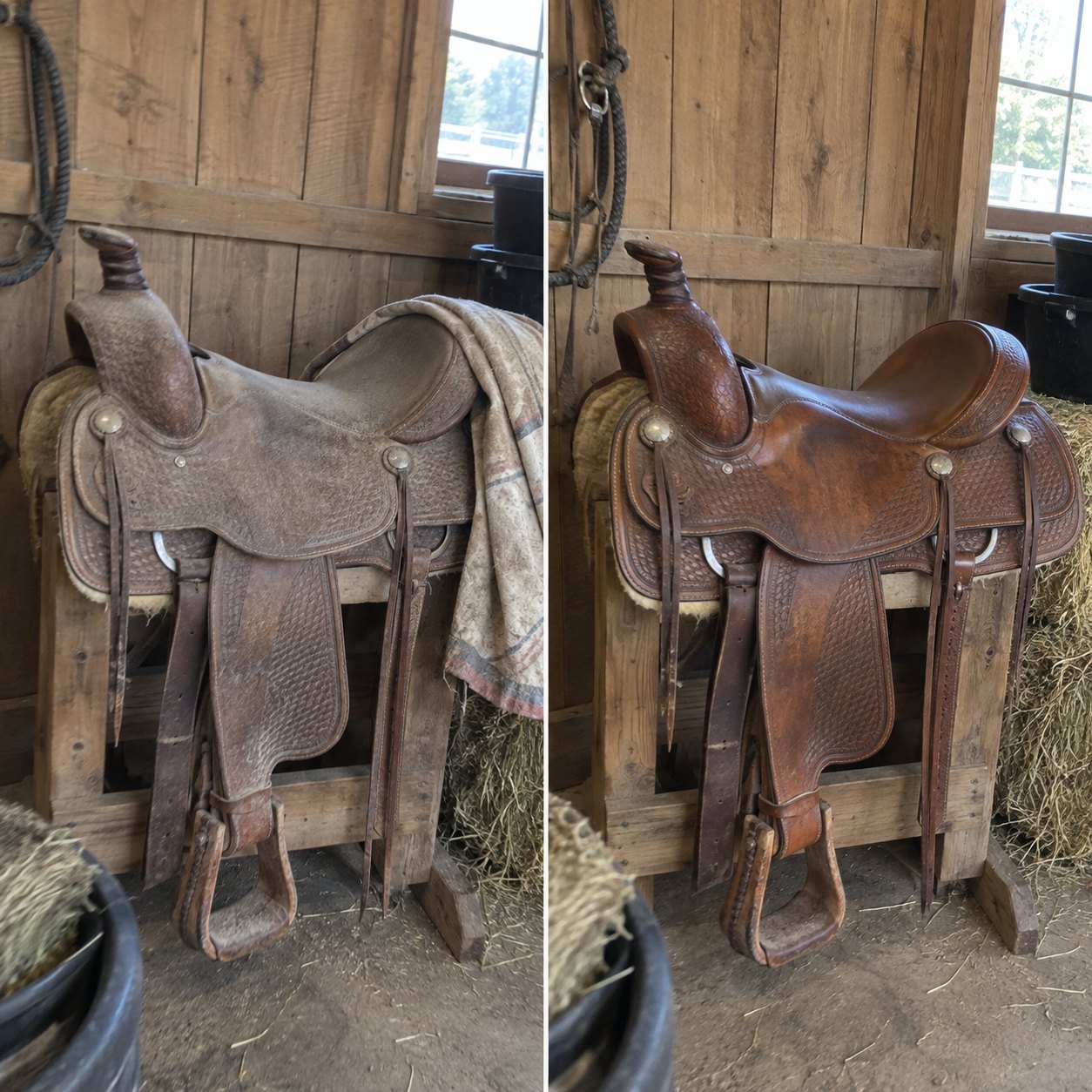
But please read the label before you buy anything.
A lot of jars on the shelf say "natural" or "beeswax" on the front and list petroleum on the back. That runs in the heat, and it's not the same thing at all.
Milim's Oath is what I keep on my bench now. Plant oils and beeswax, no petroleum, no silicone, no dye. And it has a 90-day money-back guarantee.
The only real risk here is another summer of oiling a saddle that's still dry inside, and another branding watched from the fence.
Fall Sale:
- 👉 Buy 2, Get 1 Free
- 👉 FREE shipping
- 👉 Free Gifts Included
- 👉 90-day guarantee (keep the jar, get refunded, return shipping covered)
They're a small outfit, and I've waited on a restock more than once. If you're putting your saddle away for winter, I'd feed it before you do.
★★★★★Mike J. (farrier, 30 years)"After 30 years around tack, I've seen plenty of conditioners leave stitching soft or questionable over time. That's always in the back of my mind when I put something on a saddle. I've used this on quite a few pieces now and haven't had that issue. It conditions the leather without making me second-guess what it's doing to the stitching."
P.S. From Grant
I worked as a saddler in central Queensland for 22 years. In that heat, pouring oil on a saddle and leaving it in the sun was the fastest way to ruin it. When I came to Texas and saw it handed out as the standard advice, it honestly bothered me. That's when I started showing people here what I was taught. Fewer and fewer of them come back every fall with a stiffer saddle.
P.P.S. Before you put anything on an old saddle, have a saddler check the tree, the rigging, the stirrup leathers, and the stitching. Feeding leather won't fix a crack or rotted thread. If those are sound, clean a spot, rub in a thin coat, wait 10 minutes, and buff it with a dry rag. If the rag comes away clean, the leather is taking it in.
P.P.P.S. You're covered for 90 days. They refund you, cover return shipping, and you KEEP the jar. The only way you lose is doing nothing, and putting a dry, stiff saddle away for another winter.
They Tried Everything on the Shelf First
Real experiences from people who were about to give up on their leather
The Fall Tack Sale
Unlock FREE Shipping Today

★★★★★ Trusted Customer Reviews
90-Day Money Back Guarantee
90-Day Money Back Guarantee